Choose Your Sound
Characteristic tone production on keyboard percussion instruments

Dr. Thad Anderson
University of Central Florida School of Performing Arts
Professor & Coordinator of Percussion Studies
tra@ucf.edu
www.thadanderson.com
linktr.ee/thadanderson
[!info] Keyboard percussion instruments are incredible tools for expressive music making. They require finesse, control, and sensitivity in order to allow the resonating bars to create a sound with expressive and characteristic tone quality. The keyboard percussion instrument area (or KPI for short) includes common instruments such as the marimba, vibraphone, xylophone, glockenspiel, chimes, and crotales. To focus on characteristic tone production, we will examine common methods that we use to control the sound our keyboard percussion instruments make.
Stroke
The percussion stroke is akin to the embouchure of a wind instrument player or the bow motion of someone performing on a string instrument. It is how we hold, touch, and interact with our instrument to produce tone that is essential for performing musically. Components of a basic keyboard percussion stroke include:
- Weight
- The muscle group or part of the body that is used to create a stroke helps to provide mass behind a basic stroke.
- Small muscle group:
- Fingers can be utilized to create the lightest and softest tones
- Wrists, our most common physical pivot, can also be used to create lighter tones but expand the dynamic capabilities because of the range of motion it provides.
- Medium muscle group:
- Forearm strokes pivot at the elbow and add more muscle and density to the weight of a stroke. Pitch accuracy can be affected by utilizing larger muscles due to the distance the mallet head travels away from the bars.
- Large muscle group:
- Full arm strokes, although rare, pivot at the shoulder and use the full length of the arm to help produce the heaviest of strokes.
- Small muscle group:
- The muscle group or part of the body that is used to create a stroke helps to provide mass behind a basic stroke.
- Velocity
- The speed of the stroke helps to shape the way a note speaks. Combined with specific types of weight, we can create musical articulation and dynamics.
- Staccato
- Quick or brisk stroke with smaller muscle group and less weight.
- General
- Medium speed with a general amount of weight, such as the wrist.
- Legato
- Slow, elongated stroke combined with a larger muscle group.
- Staccato
- The speed of the stroke helps to shape the way a note speaks. Combined with specific types of weight, we can create musical articulation and dynamics.
- Timbre (color or shade)
- Bright: quick, light stroke with an “immediate” sound
- Blended: general, medium weight stroke with “full” sound
- Dark: elongated, heavy stroke with a “deep” sound
To learn more about these concepts, I would highly suggest Pius Cheung’s book Colors. It also includes a set of intermediate etudes focusing on this topic.
Striking Position
The placement of where a strike is made on a keyboard percussion bar can enhance:
- musical ideas
- expression
- general tone production
A single marimba tone bar is rich in fundamental and harmonics that help to determine its characteristic timbre; it is why we enjoy performing and listening to this instrument so much.
While subtle, there are many places on a marimba bar that can provide varied tone. These elements can be described through timbre (or color), envelope (or articulation), and amplitude (or volume).
There are three basic sound types that can be created through bar placement. These can be described as full, open, and muted and can be achieved through five playing spots on each tone bar:
-
Full: round tone with more fundamental and robust volume
- Center of the bar:
- Striking the very center of the bar
- There is more fundamental in the tone
- Sounds more punchy, but also pinched or tight
- Damage, such as cracking, to natural rosewood can occur when striking here
- Center of the bar:
-
Open: straight tone with blended fundamental and harmonics 2. Slightly off center: 1. Striking just above or below the center of the bar, but still over the resonator 2. More harmonics can be heard 3. Tone is more open and straight 4. Blends better to the upper manual when playing on the edge of the bar 3. Edge of the bar: 1. Strike at the very edge of the bar 2. This will achieve a similar open or straight tone 3. Easily blend the upper manual with the lower manual
-
Thin: softer tone with even more harmonics and low amplitude
- Closer to the string node:
- Striking the bar between the center and the string, or a bit closer to the string
- The bar is thicker here so more harmonics are present
- Sounds softer than the center of the bar
- Directly over the string: 4. This area is also commonly referred to as a nodal point, but only because of the string 5. Very thin and soft sound with not a lot of tone
- Closer to the string node:
By utilizing the varied timbre, articulation, and dynamic possibilities you can achieve through bar placement, you are able to take advantage of the marimbas full quality of sound and turn that into expressive performances.
Mallet Choice
Parts and construction of a mallet:
- Core:
- This is the spherical ball found at the end of the implement
- Commonly made of:
- Latex
- Natural rubber
- Synthetic plastics
- Rosewood
- Metal
- Insert:
- Added material to the core to increase weight or density
- Typically made of brass or other metals
- Wrap:
- Material used to wrap around the core
- Typically comes in:
- Latex
- Yarn
- Cord
- Thickness
- Tightness
- Head:
- The mass at the end of the mallet is made made up by the core, insert, and wrap
- There are multiple shapes that are used for specific playing situation or instruments:
- Round
- Elongated
- Mushroom
- Shaft:
- The stick handle
- Typically made of birch, maple, rattan, or fiberglass
| Marimba | Vibraphone | Xylophone | Glockenspiel | |
|---|---|---|---|---|
| Core | Latex, natural rubber, or synthetic plastics | Latex, natural rubber, or synthetic plastics | Natural rubber, synthetic plastic, or rosewood | Synthetic plastic or metal |
| Insert | Not typical | Not typical | Not as common, but you may see brass or metal | Brass or metal |
| Wrap | Commonly yarn, but sometimes latex and cord | Commonly cord, but sometime yarn | It is possible, but we rarely use a wrapped mallet | Not typical |
| Head | Commonly round or elongated shape | Commonly mushroom shaped | Round | Round |
| Shaft | Commonly birch, but sometimes rattan | Rattan | Almost exclusively rattan | Almost exclusively rattan |
There are some additional factors to consider when seeking a desired sound on keyboard percussion instruments:
Tone color or timbre
- While composers have already selected specific keyboard percussion instruments for desired timbre (xylophone vs. marimba, etc…), performers and conductors have many options:
| Marimba | Vibraphone | Xylophone | Glockenspiel | |
|---|---|---|---|---|
| Bright | Hard plastic core with an thin elongated yarn wrap | Plastic or hard rubber core with a thin cord wrap | Hard plastic | Brass or metal |
| Moderate | Medium rubber core with a medium yarn wrap | Medium rubber core with a moderate cord wrap | Soft plastic, rosewood, or hard rubber | Hard plastic or acrylic |
| Dark | Soft rubber core with a soft, fluffy yarn wrap | Soft rubber core with a thick cord wrap | Medium rubber or hard yarn wrapped mallet | Medium to soft plastic |
Mallet weight:
- All parts of each mallet work together to determine the specific weight
- A heavier mallet produces a full-bodied sound with a lot of fundamental
- A light mallet produces a thin sound with greater harmonics
Playing position on mallet:
- Normal
- When the mallet head and shaft is horizontal to the bar
- Top or crown
- Tilting the back of the shaft up in order to play on the thicker top portion of a wrapped mallet head
- This technique only works when using a wrapped mallet
Playing position on the bar:
- Center of the bar:
- Striking the very center of the bar
- There is more fundamental in the tone
- Sounds more punchy, but also pinched or tight
- Damage, such as cracking, to natural rosewood can occur when striking here
- Slightly off center:
- Striking just above or below the center of the bar
- More harmonics can be heard
- Tone is more open and straight
- Closer to the string node:
- Striking the bar between the center and the string, or a bit closer to the string
- The bar is thicker here so more harmonics are present
- Sounds softer than the center of the bar
- Directly over the string:
- This area is also commonly referred to as a nodal point, but only because of the string
- Very thin and soft sound with not a lot of tone
Grip:
- Two-mallet
- Four-mallet
- Musser (understanding the lineage)
- Independent (i.e. Modified-Musser, Musser-Stevens, Stevens)
- Cross
- Traditional or Scissor
- Burton
- Stout or Geoffroy
- Graduated sets of mallets
- Six-mallet
Mono-tonal vs. multi-tonal:
- Mono-tonal
- A mono-tonal mallet produce one general tone, which can range from soft to hard.
- Multi-tonal or two-tone
- A multi-tonal mallet can sound soft or hard depending on the amount of velocity and weight in the stroke.
- This type of mallet has a tight wrap around the core with a very loose exterior wrap.
Envelope or ADSR curve:
- An envelope is determined by changes in amplitude or volume over a period of time.
- A sounds ensemble is measured with an ADSR curve
- Attack: initial onset of the tone when the oscillator or instrument begins to vibrate
- Decay: brief decrease in amplitude immediately after the attack
- Sustain: amplitude during the middle portion of the envelope just prior to its release
- Release: when the instrument stops producing sound
- The below “sound envelope traces” were created by Leigh Howard Stevens and are published in his book Six Suites for Marimba by J.S. Bach:
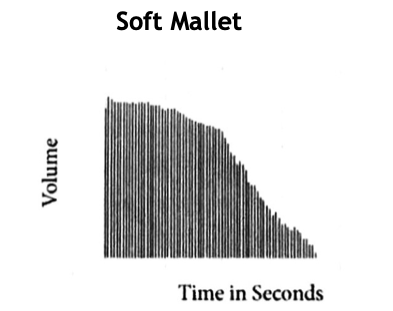
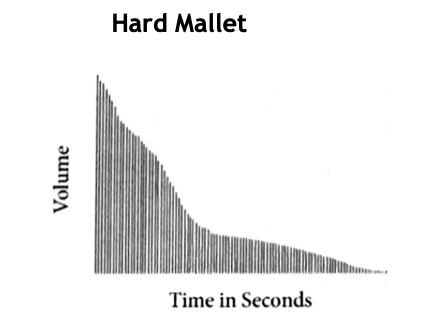
- The hard mallet has a quick decay, but continues to sustain at a soft volume
- The soft mallet has longer sustain before it decays, but does not last as long
Vic Firth “Mallet Finder” Guide: https://vicfirth.com/collections/vic-firth-category-mallets
Gesture
Performing behind keyboard percussion instruments requires athleticism and often choreographed movement. Because of the physical nature of performing behind these instruments, motions and gestures often become part of the musical interpretation and help to inform the audience about what is happening musically.
Many of the physical gestures cannot be defined and are unique to an infinite possibility of musical scenarios. My teacher, Thomas Burritt, often can be heard saying “…make your motion match the musical moment…” in lessons. Helping your audience to understand your musical intention using your body is one of the most expressive tools we have.
To better understand how the visual aspect of our movements affects our sound concept, I would recommended the following articles published in the Percussive Arts Society’s Percussive Notes journal:
The Mind of the Listener: Acoustics, Perception, and the Musical Experience Michael Schutz Percussive Notes, November 2009
Effectively Using Affective Gestures: What percussionists need to know about movement and perception Michael Schutz & Fiona Manning Percussive Notes, March 2013
For more of Michael Schutz’s work in this area, visit the Music, Acoustics, Perception, and LEarning (MAPLE) Lab website at www.maplelab.net