Microphones
Dr. Thad Anderson
University of Central Florida School of Performing Arts
Professor & Coordinator of Percussion Studies
Recording individual practice, ensemble rehearsals, and performances is an essential learning technique for all music majors. This digital handout focuses on microphones and student-oriented audio recording solutions. It is intended to aid students with making a conscious investment in tools to aid with furthering their artistic and musical goals.
Properties of Sound
Before any discussion of microphones or recording basics, it is important to fully understand the basic property of sound and its physical properties.
- Sound is a collection of waves that travel through a medium, most notably air.
- A wave refers to air pressure that moves through a room and is heard by a listener.
- Generation: To generate sound, you need a device that can cause molecules in the air to compress together and then allow them to spring apart again.
- Oscillator: Vibrating source of energy
- Propagation: Energy that has been imparted on the molecules that move through the air (compression + rarefaction).
- Reception: The receiving end of the series of compressions and rarefactions.
- A sound wave represents patterns of oscillation and a way to visually depict the movement of energy through a medium.
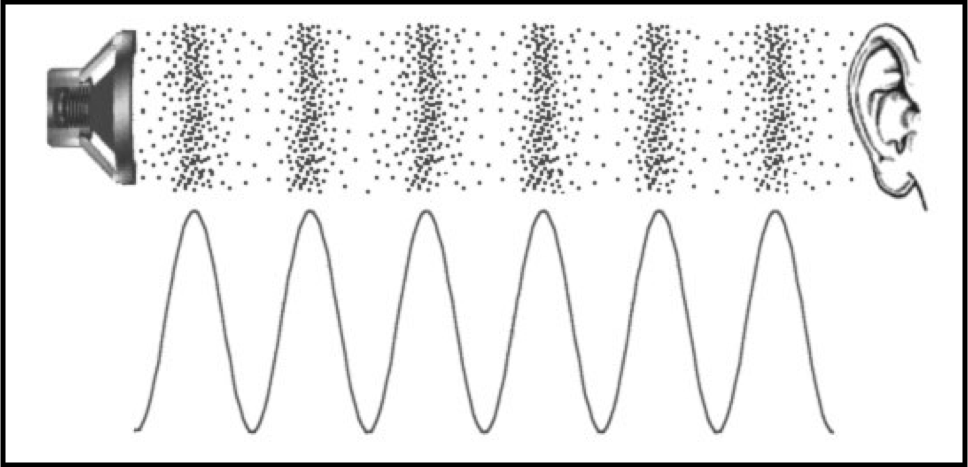
- Using a tuning fork as an example:
- A tuning fork is a metal object consisting of two tines capable of vibrating if struck.
- As the tines of the tuning fork vibrate back and forth, they begin to disturb surrounding air molecules.
- These disturbances are passed on to adjacent air molecules by the mechanism of particle interactions.
- The motion of the disturbance, originating at the tines of the tuning fork and traveling through the medium, is what is referred to as a sound wave.
Analog & Digital Concepts
All microphones are analog. They convert pressure waves that are present in the air (continuous variations in sound waves) into electricity.
Analog recording is a method of recording sound in which the electrical signals produced by a microphone are directly recorded onto a physical medium, such as magnetic tape or vinyl. The recording captures the continuous variations in sound waves, resulting in a smooth, natural sound. However, analog recordings can be susceptible to noise and distortion, and deteriorate over time with repeated playbacks.
Digital recording, on the other hand, converts the sound waves into a series of binary numbers that can be stored and manipulated by a computer. The resulting sound is precise and free from the noise and distortion that can affect analog recordings. Digital recordings can also be easily edited and manipulated, and do not deteriorate over time with repeated playbacks. However, some people feel that digital recordings can sound cold or artificial compared to analog recordings.
The choice between analog and digital recording depends on personal preference and the specific requirements of a given project or recording situation.
Types of Microphones
Microphones are devices used to convert sound waves into electrical signals. There are three main types of microphones: dynamic, condenser, and ribbon. Each type works differently to produce electrical signals from sound waves.
Dynamic Microphones
Dynamic microphones work by using a diaphragm that is attached to a coil. When sound waves hit the diaphragm, it moves back and forth, causing the coil to move in a magnetic field. This generates an electrical current that corresponds to the sound waves. Dynamic microphones are rugged and can handle high sound pressure levels, making them ideal for live performances and recording loud instruments like drums and electric guitars.
Some recommended dynamic microphones include:
These microphones are all popular and widely used in live performances, broadcasting, and recording settings.
Condenser Microphones
Condenser microphones work by using two charged plates, one stationary and one movable, to make a capacitor. When sound waves hit the movable plate, it causes it to vibrate, changing the distance between the plates and creating an electrical current. Condenser microphones are more sensitive than dynamic microphones and are commonly used for recording vocals, acoustic guitars, and other acoustic instruments. They require power to operate, either from an external power source (i.e. phantom power) or from a battery.
Some recommended small and large diaphragm condenser microphones include:
Small Diaphragm
Large Diaphragm
These are just a few examples of recommended small and large diaphragm condenser microphones. It’s important to choose a microphone that fits your specific needs and budget, and to experiment with different microphones to find the one that works best for you.
Ribbon Microphones
Ribbon microphones work by using a thin metal ribbon that is suspended in a magnetic field. When sound waves hit the ribbon, it vibrates and creates an electrical current. Ribbon microphones are known for their warm and natural sound, and are commonly used for recording vocals and acoustic instruments. They are fragile and can be easily damaged by high sound pressure levels, so they are not recommended for recording loud instruments.
Some commonly used ribbon microphones include:
- Royer R-121
- AEA R84
- Coles 4038
- Beyerdynamic M160
- AEA R44C (based on the original RCA 44)
Modeling Microphones
A modeling microphone is a type of microphone that uses digital signal processing (DSP) to emulate the sound of other microphones. This allows users to achieve a variety of different sounds without needing to purchase multiple physical microphones. These microphones are often used in recording studios and for live performances where the ability to switch between different microphone sounds quickly and easily is important.
- Townsend Labs Sphere L22
- Townsend Labs was purchased by Universal Audio. UA now has two large diaphragm modeling mics in the line-up based on the original Sphere L22:
- Slate Digital VMS (Virtual Microphone System)
Portable Microphones
- Shure MV88+ (original MV88 is now discontinued)
- Zoom iQ6
- Zoom H3-VR
Microphone Polar Pickup Patterns
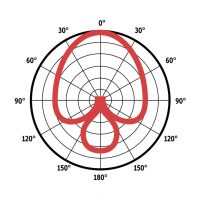
A microphone’s polar pickup pattern refers to the microphone’s sensitivity to sound from different directions. There are several different polar patterns, each with its own characteristics and intended use.
- Cardioid: This pattern picks up sound primarily from the front of the microphone, with some sensitivity to sound from the sides. It is commonly used for vocals and other solo instruments, as it provides good isolation from other sound sources.
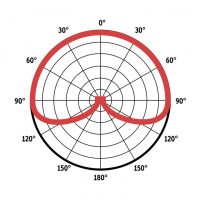
- Omnidirectional: This pattern picks up sound equally from all directions, making it ideal for recording ambient sound or group performances.
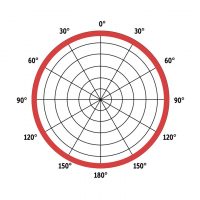
- Bidirectional or Figure-8: This pattern picks up sound equally from the front and back of the microphone, while rejecting sound from the sides. It is commonly used for recording two people or instruments at once, such as in a duet.
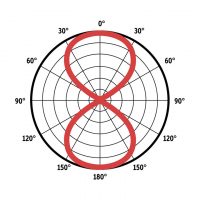
- Supercardioid and Hypercardioid: This pattern is similar to the cardioid pattern, but with a narrower pickup area and greater sensitivity to sound from the sides. It is commonly used for recording in noisy environments, as it provides good isolation from other sound sources.
Additional Recording Equipment
In order to use a microphone, additional equipment may be needed given the scenario.
- XLR or Microphone Cables
- The XLR connector is designed to provide balanced audio signals, which means that it has two conductors for carrying the audio signal, and a third conductor that is used as a ground. This helps to reduce noise and interference that can be introduced into the signal during transmission, and results in a cleaner, more accurate audio signal.
- Audio Mixer (analog or digital)
- Primarily used to mix or balance audio signals from various sources.
- They can provide phantom power for condenser microphones.
- Microphone Preamplifier (analog)
- A microphone preamplifier, is an electronic device that amplifies the low-level signal from a microphone to a line-level signal that can be recorded or amplified further.
- They can provide phantom power for condenser microphones.
- AD/DA Converter
- Conversion from analog to digital audio or digital to analog audio.
- Audio Interface
- In addition to interfacing various audio inserts to a computer, an audio interface can serve as an all-in-one mic preamp and a AD/DA converter.
- Monitors
- Monitors are speakers used to hear playback or monitor the recording process.
Recording Scenarios
Practice or Rehearsal
In practice and rehearsal it is ideal to have a solution that is quick and allows for easy access to the files for reviewing playback. In our modern bring-you-own-device world, using a smart phone or tablet to record is simple and convenient. Here are some iOS and iPadOS apps that are quick and easy:
Add a physical microphone for better sound quality and more control:
Auditions
Any audition recording (graduate school, festivals, competitions, scholarships, etc…) will most likely involve needing video. You can speed up the process of editing audio and video by combining them in real-time. This involves using a good microphone and recording directly to the video.
We have a Canon XA-20 HD camera that has two XLR inputs for recording with a stereo pair or single stereo mic. This can be checked out from Dr. Anderson’s office.
The Shure MV88+ that is mentioned above can also be another solution to accomplish this.
Live Performances
The importance of any given live performance may help to determine which recording setup you decide to use. Most important is reliability. A trusted setup up with a microphone you know well is ideal. This setup should involve a stereo image (either a single stereo mic or a matched stereo pair), a high-quality mic preamp, and a recording device. An audio interface with a good preamp and a computer might be the best solution here.
Instrument Solutions
Drum Set
- Membranes
- Common to close mic, which is to place a dynamic microphone directly over the membrane surface.
- Snare
- In addition to a dynamic microphone on the batter side, it’s common to place a second dynamic mic on the snare side.
- Kick drum
- Dynamic kick mic
- Low-frequency capture mic
- Yamaha Subkick (discontinued)
- Solomon LoFReQ
- Cymbals
- Overhead mics
- Reverberant idiophones are best captured by condenser microphones at further distances.
- Overhead mics
- Mic packs
- Yamaha EAD10 (Electronic Acoustic Drums)
Keyboard Percussion
- Marimba and vibraphone should be treated with a pair of overhead condenser microphones (either small or large diaphragm).
- One condenser microphone will be sufficient for KPIs with smaller range like xylophone, glockenspiel, chimes, and crotales.
Orchestral Instruments and Accessories
- Small or large diaphragm condenser out in front or overhead.
Large Membranophones
- Large diaphragm condenser out in front or overhead.
Recording Production in the Rehearsal Hall
Here is the signal chain that we use for audio recording in the Rehearsal Hall:
- Microphone
- Schoeps MSTC 74 U ORTF Stereo Microphone
- The stereo microphone captures a stereo (left and right) sound field, which is best listened to using a pair of speakers or headphones.
- ORTF is a stereo recording technique that uses two cardioid microphones placed 17 cm apart and angled at 110 degrees. The capsules should be angled outward at a 55-degree angle. The ORTF technique provides a good stereo image with good localization, and is often used for recording acoustic ensembles and orchestras.
- Devised around 1960 by the Office de Radiodiffusion Télévision Française (ORTF).
- XLR cables
- A 5-pin XLR breakout cable is needed for the stereo microphone.
- This splits into two XLR cables, the left and right stereo image signals, and connects to the stage box.
- Stage box
- The stage box is located on stage in the Wenger cabinet.
- It provides 48v of phantom power for the stereo condenser microphone and is controlled by the digital mixer in the sound booth.
- It converts the analog signal provided by the microphone to digital (A to D).
- It connects to a CAT5 port in the wall and sends a digital signal to the mixer located in the sound booth.
- Digital mixer
- The digital mixer receives the signal via the CAT5 cable (technology called Dante) and converts it back to analog.
- It then sends the analog signal to the audio interface (D to A).
- Audio interface
- Universal Audio Apollo Twin X
- Receives the analog signal from the mixer and converts it to digital (A to D).
- Interfaces with computer using a thunderbolt connection.
- The interface is also used to send audio out to headphones or the studio monitors.
- Computer
- 2021 iMac desktop computer.
- The computer receives the digital information from the audio interface and records that information to a digital audio workstation (DAW).
- We use LUNA, a DAW that is made by Universal Audio and works closely with the audio interface hardware.
- Monitors
- There are a pair studio monitors so that the engineer can monitor what is happening live on stage or listen back to audio that has already been recorded.
Copyright © Thad Anderson, 2026, Plus Two Media (ASCAP), All Rights Reserved